More and more lately, I'm discovering that I prefer books based in reality. My reality, that is, which does not include magic, ghosts or people coming back from the dead. And yet I've recently read not one but two books that had as a central theme the idea of reincarnation. According to Wikipedia, reincarnation is:
"believed to occur when the soul or spirit, after the death of the body, comes back to life in a newborn body. This phenomenon is also known as transmigration of the soul or metempsychosis."
For Pump Up Your Book Promotions, I recently read "The Hypnotist" by M.J. Rose (my review here), the third book in the Reincarnationist series. Out of my comfort zone, to be sure; but I'm always in search of something new.
Imagine my surprise, a week later, to pick up the book my daughter brought home from English class and discover that its story line used the tool of reincarnation to explore destiny versus free will. My review of this book, "The Returners" by Gemma Malloy, will be coming soon. This book will make you hope that reincarnation is not real!
Thanks to all of the bloggers who love Young Adult books for convincing me to pick up the books my daughter brings home to read along. There are really some terrific books out there that explore very adult ideas in ways that are relatable for young people.
Showing posts with label All Things In Common. Show all posts
Saturday, October 16, 2010
Friday, August 27, 2010
All Things In Common
That same day I was listening to APR's The Story and Dick Gordon was talking to Dennis Reed, who was an amateur photographer 30 years ago when he came across the work of Japanese American art photographers who had been forced to hid their work when they were sent to Japanese internment camps (a subject I'd discovered had recently come up in several reads). Some of these photographers managed to make cameras out of materials they were allowed to have in the camps. As stark and barren as the other photographs I've seen of these camps are, these make them look so much worse.
Have you discovered any themes recurring in your reading?
Sunday, July 11, 2010
All Things In Common
On of my favorite books last year was Jamie Ford's "Hotel On The Corner Of Bitter And Sweet" which, in large part dealt with the internment of Japanese Americans during World War II. It was certainly not the first time I had heard of the internment but it definitely opened my eyes as to the way the movement of these people was handled. And it was the first time I recalled reading a book that talked about this part of American history.

Then, just a few months later, I picked up Jean Davies Okimoto's "The Love Ceiling." The mother of the lead character, Anna, was Japanese and her family had been sent with other Seattle area Japanese Americans to an internment camp in Minidoka, Idaho, the same camp that the characters in "Bitter and Sweet" were sent to.
This is that camp. Can you even imagine what it felt like to come from verdant, wet Seattle to this? To say nothing of having to give up nearly everything that you owned, never to get it back? To be honest, given the fact that Russian spies were just found to have been living deep undercover in the U.S., I can somewhat understand why Americans would have been concerned that there might be some spies amongst the Japanese in America. But it is almost beyond comprehension that an entire population, nearly all innocent of any wrongdoing, would be stripped of nearly everything they own, sent hundreds of miles away from their homes and put into camps that were not nearly sufficient to handle the number of people they had to handle nor the climate in which they were located. Shameful.Thanks to both of these authors for bringing this part of our history into the light.
Tuesday, June 15, 2010
All Things In Common
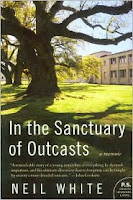
Blackwell had this to say about Carville:
"Lepers entering the colony at Carville in the early decades of the twentieth century were encouraged, if not coerced, to change their names. It was thought that both the lepers and their families were better off parting ways for good."
"Many a carefully drawn family tree had a stunted limb, a truncation bearing only the first name of an aunt or uncle or cousin who - though everyone had known where he or she had been taken - had disappeared as if forever into the mysterious word Carville."
White tells us this about the start of the colony at Carville:
"The plantation sat in disrepair, unoccupied for thirty years, before the State of Louisiana leased the land in 1894. The 360-acre plot, along with a decaying manor house and slave quarters, was then designated as the Louisiana Leper Home. After that, all lepers in Louisiana were sent to the remote colony. The geography was perfect for outcasts. The plantation was virtually impossible to reach by land...In the early days, doctors and nurses were reluctant to come to the home. There was no running water, little sanitation, and no budget for improvement. The first residents shared the buildings with snakes and bats."
According to White, the severity of leprosy depends on a person's natural immunity. Those with higher immunity may only notice a lighter patch of skin on their legs. In the most severe cases, the disease (which is a bacteria) can actually eat away flesh. There is, to this day, no vaccine against leprosy but there are treatments. There are approximately 6500 case of leprosy in the U.S., 3300 are active but these days, victims are able to continue with their lives as they receive treatment.
As you can see from the above shot, all of the buildings are connected with covered hallways.
Patients no longer live at Carville. It is now the National Hansen's Disease Museum. I found out more about the disease at the U.S. Department of Health and Human Services website.
Tuesday, June 1, 2010
All Things In Common

In the past six months, I've read The Lotus Eaters, Letter To My Daughter and Let The Great World Spin, all of which had the Vietnam War a setting for a least a part of the book. In The Lotus Eaters, nearly the entire book is set in Vietnam. In Let The Great World Spin, it pays a pivotal role in one of the story of one of the characters. In Letter To My Daughter, the boyfriend that the mother is telling her daughter about enlists and is sent to Vietnam. Any theories why Vietnam is showing up in so many recently published books?
Subscribe to:
Posts (Atom)